
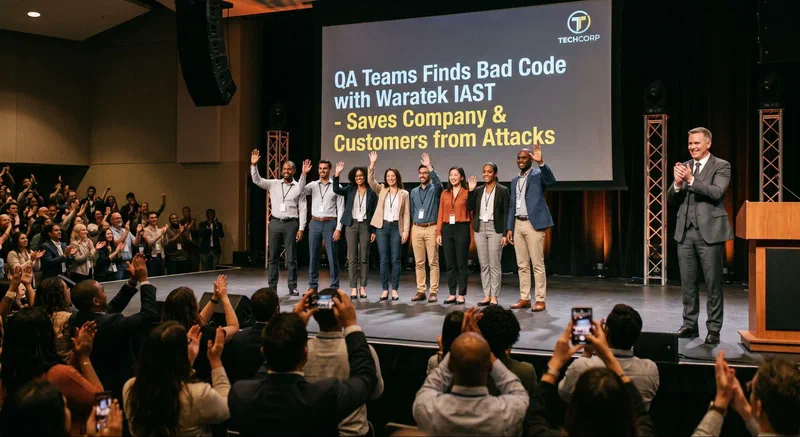
Organizations running enterprise Java applications do not need to choose between release speed and thorough application security. By combining Interactive Application Security Testing (IAST) with existing Quality Assurance (QA) automation pipelines, security teams can evaluate code during routine functional testing. This approach expands security coverage, eliminates false positives, and speeds up release cycles without creating extra work for QA engineers.
Target Audience: Application Security (AppSec) Professionals, CISOs, CTOs, Engineering Leadership, and QA Directors managing enterprise Java applications.
Key Takeaways
- Piggyback Security on QA: Waratek IAST integrates directly into existing functional test runs (JUnit, Selenium), evaluating code security during normal QA workflows.
- Zero Added Time: Security analysis occurs concurrently with functional testing, adding no extra duration to the build or testing pipeline.
- High Accuracy: Operating inside the Java Virtual Machine (JVM) provides full context, reducing false positives and giving developers precise, actionable reports.
- Better ROI: Companies gain comprehensive security coverage by making full use of existing QA automation investments rather than buying separate, isolated scanning tools.
In the high-stakes world of mission-critical Java applications, the speed versus security debate is a common challenge. Many organizations accept an unnecessary compromise: pouring resources into Quality Assurance (QA) to ensure business logic works, while Application Security (AppSec) operates in a separate, isolated channel.
Your existing QA investment offers an untapped opportunity for application security.
The Untapped Potential in Functional Test Suites
QA teams regularly run thousands of functional tests through commonly used frameworks. These scripts exercise core application pathways to verify user experience and system stability.
Standard functional tests evaluate expected application behaviors. Security tests evaluate unauthorized actions. Traditionally, bridging this difference required building separate security test suites, demanding extra time and engineering resources.
The Waratek Synergy: Piggybacking Security onto QA Automation
Waratek Interactive Application Security Testing (IAST) changes this equation by integrating into existing workflows. Instead of deploying complex, isolated security infrastructure, organizations can connect Waratek directly to current QA automation routines.
This integration follows a straightforward path:
- Simple Deployment: Deploy the agent directly into your designated QA or testing environment.
- Continuous Monitoring: As testing scripts execute, the engine monitors internal Java application execution pathways in real time.
- Automated Vulnerability Detection: When functional tests execute specific application routines, the system evaluates those pathways for critical risks like SQL Injection, Cross-Site Scripting (XSS), and insecure deserialization.
Every automated functional test functions as a security test, requiring no changes to daily workflows.
Strategic Advantages for Executive Leadership
For CISOs, CTOs, and AppSec leaders, connecting security directly to QA provides several operational benefits:
- Efficient Resource Utilization: Organizations maximize existing QA infrastructure and test suites instead of adding redundant scanning environments.
- Predictable Release Schedules: Security assessments occur at the same time as QA routines, keeping release timelines intact.
- Expanded Engineering Scope: QA teams generate detailed security data automatically without needing specialized cybersecurity backgrounds.
High Accuracy and Minimal Noise
Traditional security scanners often produce high volumes of false positives, causing investigation fatigue for development teams. Because Waratek operates inside the runtime environment, it monitors code execution directly. When a vulnerability is reported, it reflects a verified code execution path, giving developers exact line-item context for faster fixes.
Engineering Built-In Application Resilience
For enterprise Java applications, maintaining continuous speed while managing application risk is essential. Combining Waratek IAST with standard QA automation builds security directly into the software development lifecycle, protecting applications without slowing down innovation.
Want to see Waratek IAST in action? Ask for a free trial today.
Frequently Asked Questions
How does IAST differ from SAST and DAST?
Static Application Security Testing (SAST) analyzes source code without executing it, which often leads to high false positive rates. Dynamic Application Security Testing (DAST) tests running applications from the outside but lacks visibility into the internal code layout. IAST operates from inside the runtime environment during actual code execution, delivering high accuracy and deep code-level insights.
Does adding Waratek IAST slow down automated QA test runs?
No. The engine operates inside the execution layer with minimal processing footprint, allowing automated scripts to finish within standard time windows.
Do QA engineers need cybersecurity training to use this approach?
No special security training is required for QA staff. Test engineers write and run standard functional scripts as usual, while the security engine handles vulnerability identification behind the scenes.
Does this approach require changes to source code?
No source code modifications or manual re-architecting are necessary. The application agent runs at the environment layer to monitor data flows during normal execution.