
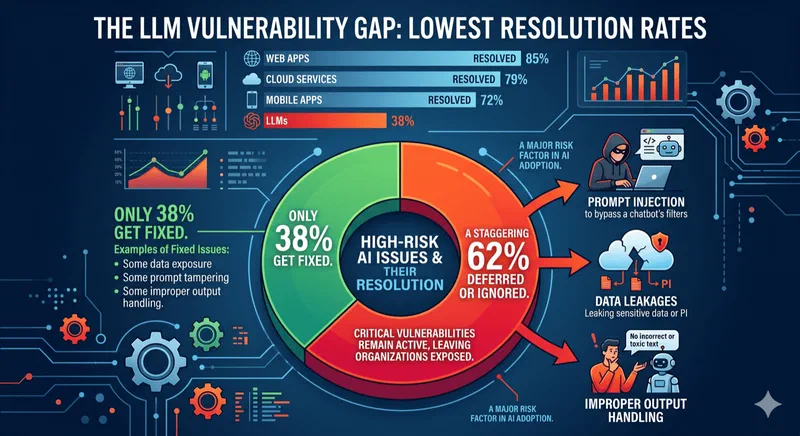
The rapid adoption of Large Language Models (LLMs) has outpaced our ability to secure them. Currently, 62% of high-risk AI vulnerabilities go unfixed because traditional patching methods-like updating a library-don’t apply to the non-deterministic nature of neural networks. This blog explores why the “remediation gap” exists and how Runtime Application Self-Protection (RASP) secures AI assets without waiting for costly model re-training.
🎯 Who Should Read: AppSec Managers, DevOps Leads, and Senior Software Architects.
Key Highlights
- The Resolution Crisis: AI applications have a 38% fix rate, the lowest in the software industry.
- The Remediation Bottleneck: Why prompt engineering and re-training are failing to keep up with agile deployment.
- RASP as a Virtual Patch: How runtime protection intercepts attacks at the execution layer.
- Buying Time: Using RASP to protect vulnerable assets while developers work on permanent architectural fixes.
Recent industry data reveals a hard pill to swallow: LLMs have the lowest resolution rate of any application type. Only 38% of high-risk AI issues actually get fixed. This means a staggering 62% of critical vulnerabilities in AI-driven applications remain “deferred” or ignored, leaving organizations exposed to prompt injections, data leakages, and improper output handling.
But why is the fix rate so dismal compared to traditional software? And how can AppSec teams close the gap without halting innovation?
The Bottleneck: Why AI Requires More
In traditional applications, a high-risk vulnerability often involves a known CVE in a third-party library. The fix is straightforward: update the dependency, test, and deploy. AI is different. When an LLM triggers an Improper Output Handling (OWASP LLM05) vulnerability-where the model generates malicious code or sensitive data that is then executed by the backend-the remediation path is rarely a simple code change.
Developers are currently overwhelmed because fixing a neural network’s logic often requires:
- Complex Prompt Engineering: Trying to “blacklist” behaviors via system prompts, which is notoriously easy to bypass.
- Model Re-training: A costly, time-consuming process that can take weeks or months.
- Architectural Overhauls: Redesigning how the application interacts with the model.
When faced with these hurdles, “High Risk” tickets don’t get resolved; they get backlogged.
Enter the RASP Safety Net: A Virtual Patch for AI
This is where Waratek RASP changes the math for AppSec Managers and Lead Developers.
If you cannot fix the model’s “brain” immediately, you must secure the environment in which it operates. Waratek RASP acts as a “virtual patch” for your AI stack. By residing inside the application runtime, RASP monitors the inputs and outputs of your LLM in real-time.
How RASP Solves the Remediation Crisis:
- Intercepts Attacks in Real-Time: Even if an LLM produces a “poisoned” output, RASP identifies the malicious pattern at the execution layer and blocks it before it can cause harm to your database or end-user.
- Decouples Security from Development: You no longer have to wait for a 6-week retraining cycle to be secure. RASP provides immediate protection, allowing your developers to focus on the long-term fix without the “front door” being left wide open.
- Zero-Day Protection: Because RASP looks at behavior-not just known signatures-it can block novel prompt injection attacks that your current filters might miss.
Closing the Gap: From “Deferred” to “Protected”
The 62% of unfixed AI flaws represent a massive surface area for attackers. However, for a DevOps team using Waratek, a “deferred” ticket doesn’t mean a “vulnerable” asset.
By implementing RASP, you buy your development team the most precious commodity in AppSec: time. You turn a critical security debt into a managed risk, ensuring that while your LLMs continue to evolve, your enterprise remains shielded.
Don’t let the remediation crisis stall your AI roadmap.
Want to see how RASP can avoid the remediation crisis for your team? Book a demo with Waratek today.