
Summary
- Since 2015, the same WebLogic bug class — unauthenticated Java deserialization over T3, IIOP and HTTP — has produced dozens of CVEs and still counting.
- Each fix added the last exploit’s classes to a blocklist. Each new CVE found classes or wrappers the blocklist didn’t cover.
- We replayed a representative sample of 12 of these CVEs against a range of WebLogic versions with the Waratek agent attached.
- 11 of the 12 CVEs score CVSS 9.8. Our Java CVE database (VRT) shows 9 of them exploited in the wild, and 5 are on CISA’s Known Exploited Vulnerabilities list.
- The Waratek agent Deserial security rule — no list of classes in it, unchanged — blocked every exploit we replayed.
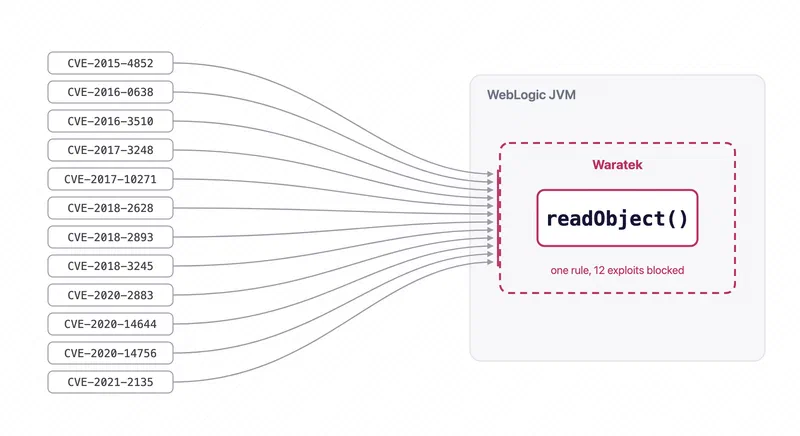
Since 2015 Oracle has shipped dozens of fixes for one WebLogic bug. The server deserializes Java objects that anyone on the network can send it. Each fix added the latest exploit’s classes to a blocklist, and each time researchers found a way around it. We picked 12 of those exploits that between them cover the different ways attackers got around the fixes, and replayed them against WebLogic with the Waratek agent attached. One rule, with no list of classes in it, blocked all 12.
Attackers didn’t treat these as theory. Our Java CVE database (VRT) shows 9 of the 12 exploited in the wild, 5 of them on CISA’s Known Exploited Vulnerabilities (KEV) list, and the bypass that followed CVE-2017-10271 was spreading ransomware before Oracle had a fix for it.
How the bug works
WebLogic talks to clients over T3, its own version of Java’s RMI, the protocol Java programs use to call methods on objects in another JVM. T3 runs on the same port as the web console (7001 by default). A T3 message carries serialized Java objects, and the server rebuilds them before it checks who sent them. So anyone who can reach the port can make WebLogic run the readObject code of any class on its classpath.
That code is usually harmless. But libraries like Apache Commons Collections, and Oracle’s own Coherence, ship classes that call other objects’ methods while they deserialize. Chain enough of those together and you reach Runtime.exec. The attacker sends one crafted object and the server runs a shell command. Nobody logs in.
This kind of chain is called a gadget chain, and there is no shortage of them. AI now finds new ones in seconds. That is the root of the patch history below.
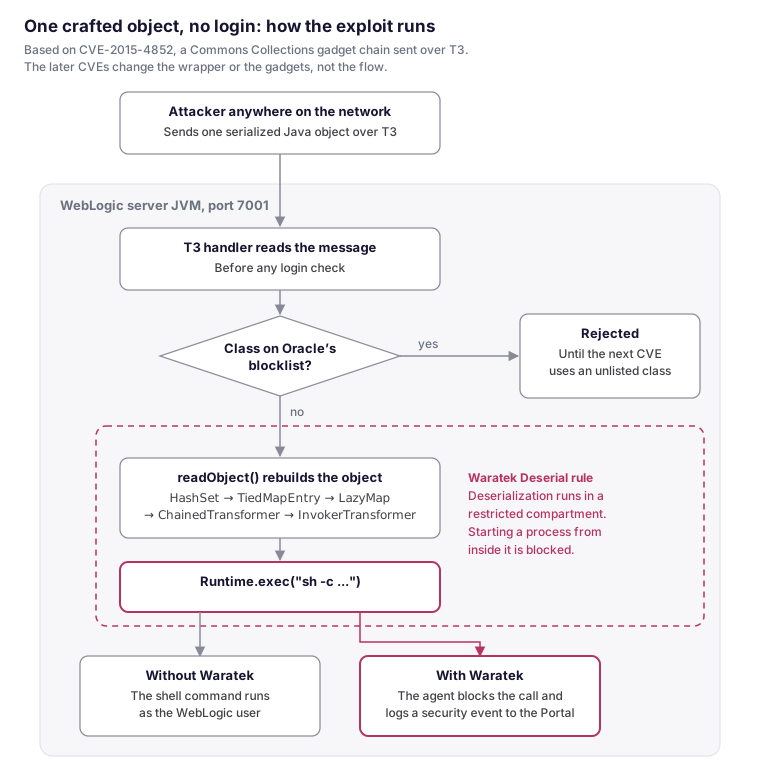
In our CVE-2015-4852 test the chain is short. HashSet.readObject() puts its entries back into a map, which calls hashCode() on a TiedMapEntry. That calls LazyMap.get(), which hands the key to a ChainedTransformer. Its InvokerTransformer steps use reflection to fetch Runtime.getRuntime() and call exec() with the attacker’s command. Every one of those classes is ordinary library code doing what it was written to do.
What an exploit looks like
The T3 payloads are binary, but CVE-2017-10271 does the same thing in XML, so you can read it. This is the request body an attacker POSTs to /wls-wsat/CoordinatorPortType, with the command swapped for a harmless one:
<soapenv:Envelope xmlns:soapenv="http://schemas.xmlsoap.org/soap/envelope/">
  <soapenv:Header>
    <work:WorkContext xmlns:work="http://bea.com/2004/06/soap/workarea/">
      <java version="1.8.0" class="java.beans.XMLDecoder">
        <void class="java.lang.ProcessBuilder">
          <array class="java.lang.String" length="3">
            <void index="0"><string>/bin/sh</string></void>
            <void index="1"><string>-c</string></void>
            <void index="2"><string>id > /tmp/proof</string></void>
          </array>
          <void method="start"/>
        </void>
      </java>
    </work:WorkContext>
  </soapenv:Header>
  <soapenv:Body/>
</soapenv:Envelope>
WebLogic hands the WorkContext header to Java’s XMLDecoder, which treats the XML as instructions. It builds a ProcessBuilder for /bin/sh -c "id > /tmp/proof" and calls start(). No login, no file upload, one HTTP request.
Exploits like this aren’t hard to find. ysoserial generates the T3 gadget chains, and Metasploit ships ready-made modules for CVE-2017-10271 and CVE-2018-2628. Our tests use payloads of the same shape, with the command replaced by one that writes a marker file.
Six years of patches
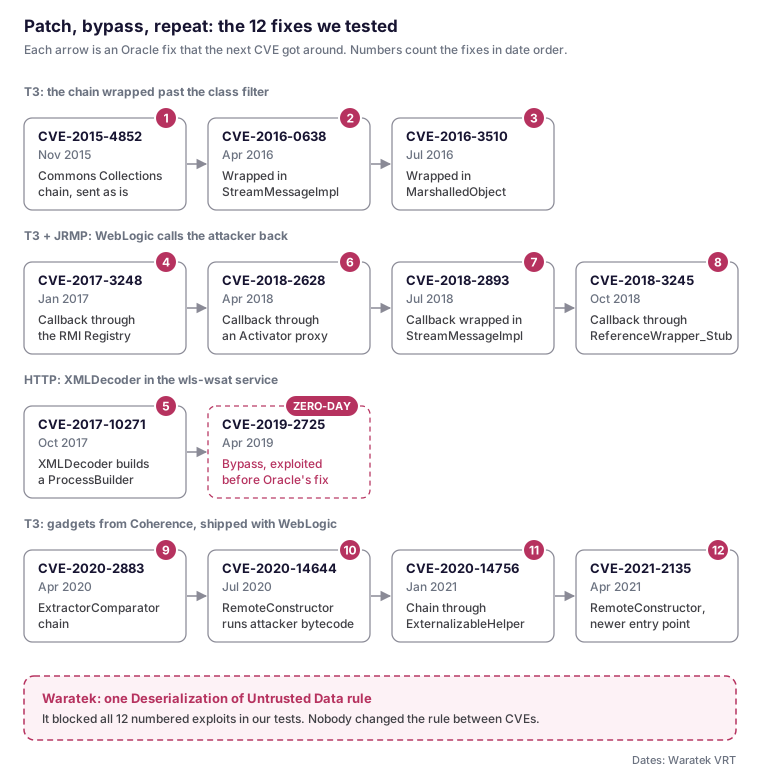
Oracle’s fix for CVE-2015-4852 added a class filter to the T3 handler. Five months later CVE-2016-0638 wrapped the same chain inside a StreamMessageImpl, which deserializes its contents through a second stream the filter never saw. CVE-2016-3510 did the same with MarshalledObject.
In 2017 the attacks changed shape. The JRMP variants send a small object that makes WebLogic open an RMI connection back to the attacker, and the real payload arrives on that connection. After CVE-2017-3248, Oracle blocked the Registry interface, so CVE-2018-2628 used Activator instead. Then came the wrapper trick again (CVE-2018-2893) and another stub class (CVE-2018-3245).
The same pattern ran over HTTP. CVE-2017-10271 used XMLDecoder in the wls-wsat web service to build a ProcessBuilder. Oracle’s fix blocked certain XML elements, and CVE-2019-2725 got around it.
From 2020 the gadgets came from Coherence, which ships with WebLogic. CVE-2020-2883, CVE-2020-14644, CVE-2020-14756 and CVE-2021-2135 each found new classes after the last fix blocked the old ones.
These 12 are only the ones we tested. WebLogic has had dozens of deserialization CVEs, and the fixes didn’t stop in 2021. In October 2024 Oracle was still patching a critical bug that anyone could reach over T3 and IIOP without logging in (CVE-2024-21216).
Attackers didn’t wait for the patch cycle
Every one of these CVEs had a fix. The danger was the gap between Oracle shipping it and a team rolling it out, and attackers were often faster.
With CVE-2019-2725, the bypass of the CVE-2017-10271 fix, there was no gap at all. Cisco Talos saw attackers exploiting it from at least 17 April 2019, and by 25 April it was dropping Sodinokibi ransomware. Oracle shipped an emergency fix on 26 April. CVE-2018-2893 was attacked three days after Oracle patched it, once proof-of-concept code showed up on GitHub. CVE-2020-2883 took about two weeks, and CISA put out an alert telling teams with unpatched WebLogic servers to act.
The old CVEs didn’t go away either. CVE-2015-4852 was patched in 2015, and five years later the NSA named it as one of the vulnerabilities Chinese state-sponsored actors were using. CVE-2017-10271 became a favourite of cryptomining crews, and CISA records known ransomware use. Forescout found CVE-2020-14644 in a Hunters International ransomware intrusion. And in 2025 GreyNoise still listed CVE-2018-2628 in its report on mass internet exploitation.
A patch can only block an exploit someone has already seen, and only after it’s installed. A rule that blocks the behaviour is already in place on the day the next bypass is published, so there’s no window to race, even when the bypass is a zero-day.
How Waratek blocks the whole class
A blocklist asks “is this class dangerous?” and someone has to keep the answer up to date. Waratek’s Deserial security rule doesn’t ask about classes. It places every deserialization operation in a restricted compartment at runtime, so a gadget chain that tries to start a process is stopped whichever classes it is built from.
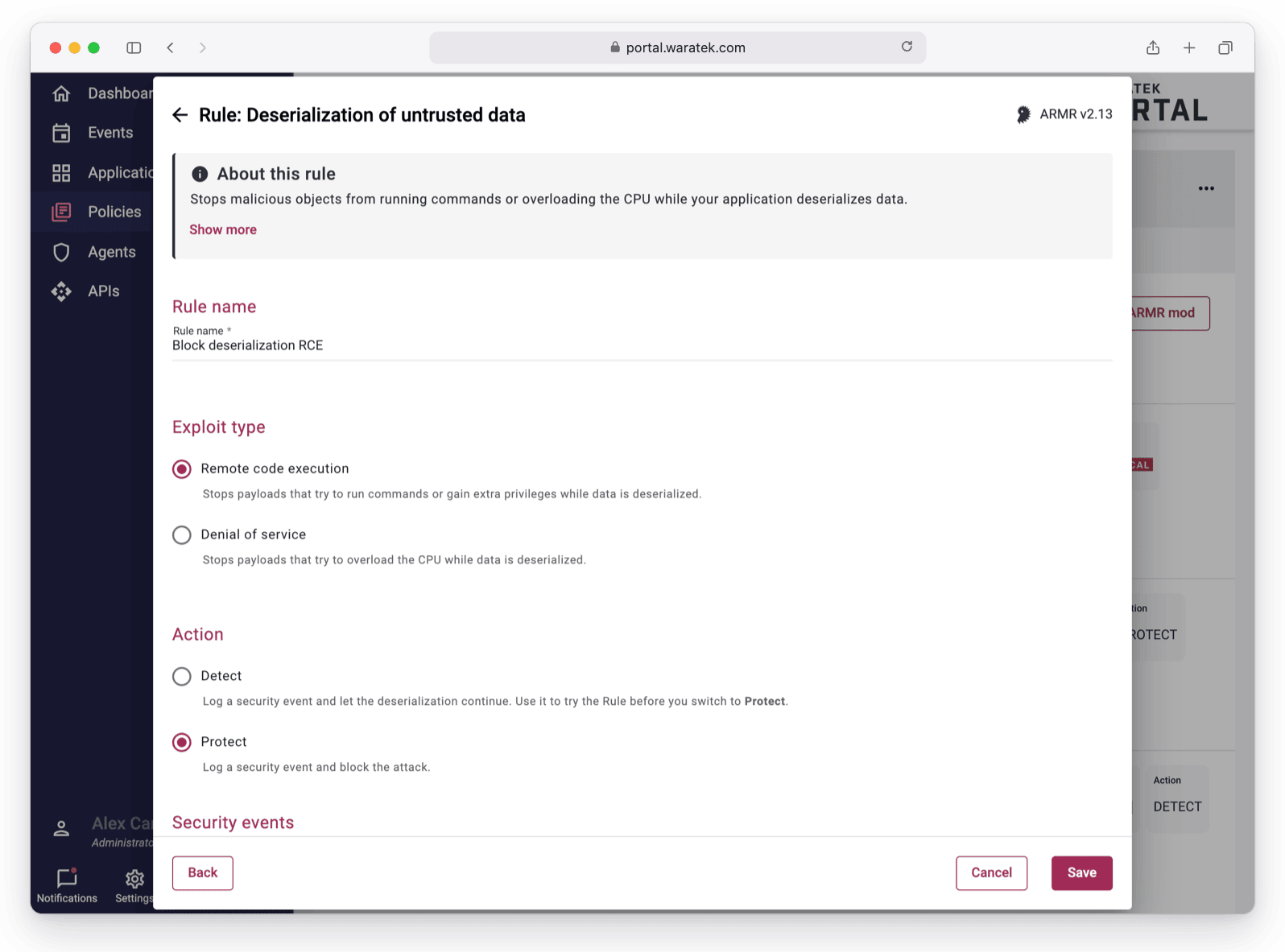
In the Portal’s Rules Wizard that is one rule: Deserialization of Untrusted Data, with the exploit type set to Remote code execution and the action set to Protect. It names no classes, libraries or CVEs, so there is nothing to update when the next bypass comes out.
The agent runs inside the JVM, so it sees the call to Runtime.exec while the attacker’s object is still being rebuilt. It stops the call there and logs a security event to the Portal. In Detect mode the agent logs the attack and lets it run. We used that mode as our control in the tests below.
What we tested
We ran each exploit twice against an unpatched WebLogic install with the agent attached. In Detect mode the payload wrote a marker file to disk, which proves the exploit really worked. In Protect mode no marker file appeared and the agent logged the blocked call: Runtime.exec for the gadget chains, and the ProcessBuilder for the XML exploit.
| CVE | Vector | What the payload does |
|---|---|---|
| CVE-2015-4852 | T3 | Commons Collections chain, sent as is |
| CVE-2016-0638 | T3 | Same chain wrapped in StreamMessageImpl |
| CVE-2016-3510 | T3 | Same chain wrapped in MarshalledObject |
| CVE-2017-3248 | T3 + JRMP | Makes WebLogic call back to an attacker’s RMI listener, which returns the chain |
| CVE-2018-2628 | T3 + JRMP | Same callback through an Activator proxy |
| CVE-2018-2893 | T3 + JRMP | Callback wrapped in StreamMessageImpl |
| CVE-2018-3245 | T3 + JRMP | Callback through ReferenceWrapper_Stub |
| CVE-2017-10271 | HTTP (wls-wsat) | XMLDecoder builds a ProcessBuilder |
| CVE-2020-2883 | T3 | Coherence ExtractorComparator chain |
| CVE-2020-14756 | T3 | Coherence chain through ExternalizableHelper |
| CVE-2020-14644 | T3 | Coherence RemoteConstructor defines and runs attacker bytecode |
| CVE-2021-2135 | T3 | Coherence RemoteConstructor through a newer entry point |
We used the same rule with the same settings for all 12 runs. The configuration that blocked the 2015 exploit also blocked the 2021 one.
Under the hood: rules as code
Most teams set up rules in the Portal and the Rules Wizard and never see what’s underneath. Behind them is ARMR, a small DSL for writing agent rules. Teams that keep security config in Git, or give the agent a local rules file, can write ARMR directly. This is the rule we used for all 12 tests:
marshal("Block RCE during deserialization"):
    deserialize(java)
    rce()
    protect(message: "Deserialization RCE blocked", severity: High)
endmarshal
deserialize(java) scopes the rule to Java deserialization and rce() names the behaviour to stop. protect blocks the call and logs it. Swap it for detect and the agent only logs.
If you run WebLogic
Patch. Oracle’s fixes are still the first line of defence, and every CVE in this post has one. But the history shows what a blocklist patch protects you from: the last exploit, not the next one. Each bypass gave attackers a window between disclosure and your next patch cycle, and in 2019 attackers had a bypass before there was any patch to install.
A few things help regardless of patch level:
- Don’t expose T3 or IIOP to the internet. Most of these attacks needed nothing more than network access to port 7001.
- Remove
wls-wsatand_asyncif you don’t use them. - Put a control on the behaviour, not the class list. A deserialization that starts a process is an attack whichever gadget chain caused it, and that’s the check Waratek’s Deserial rule makes.
References
- Waratek VRT, Java vulnerability data for every CVE in this post: https://vrt.services.waratek.com
- Cisco Talos, Sodinokibi ransomware exploits WebLogic (CVE-2019-2725): https://blog.talosintelligence.com/2019/04/sodinokibi-ransomware-exploits-weblogic.html
- CISA, unpatched Oracle WebLogic servers vulnerable to CVE-2020-2883: https://cisa.gov/news-events/alerts/2020/05/01/unpatched-oracle-weblogic-servers-vulnerable-cve-2020-2883
- Forescout, anatomy of a Hunters International ransomware attack (CVE-2020-14644): https://www.forescout.com/resources/anatomy-of-an-attack-hunters-international-ransomware/
- GreyNoise, 2025 Mass Internet Exploitation Report (CVE-2018-2628): https://info.greynoise.io/hubfs/resources/GreyNoise-2025-Mass-Internet-Exploitation-Report.pdf
- CISA Known Exploited Vulnerabilities catalog: https://www.cisa.gov/known-exploited-vulnerabilities-catalog